


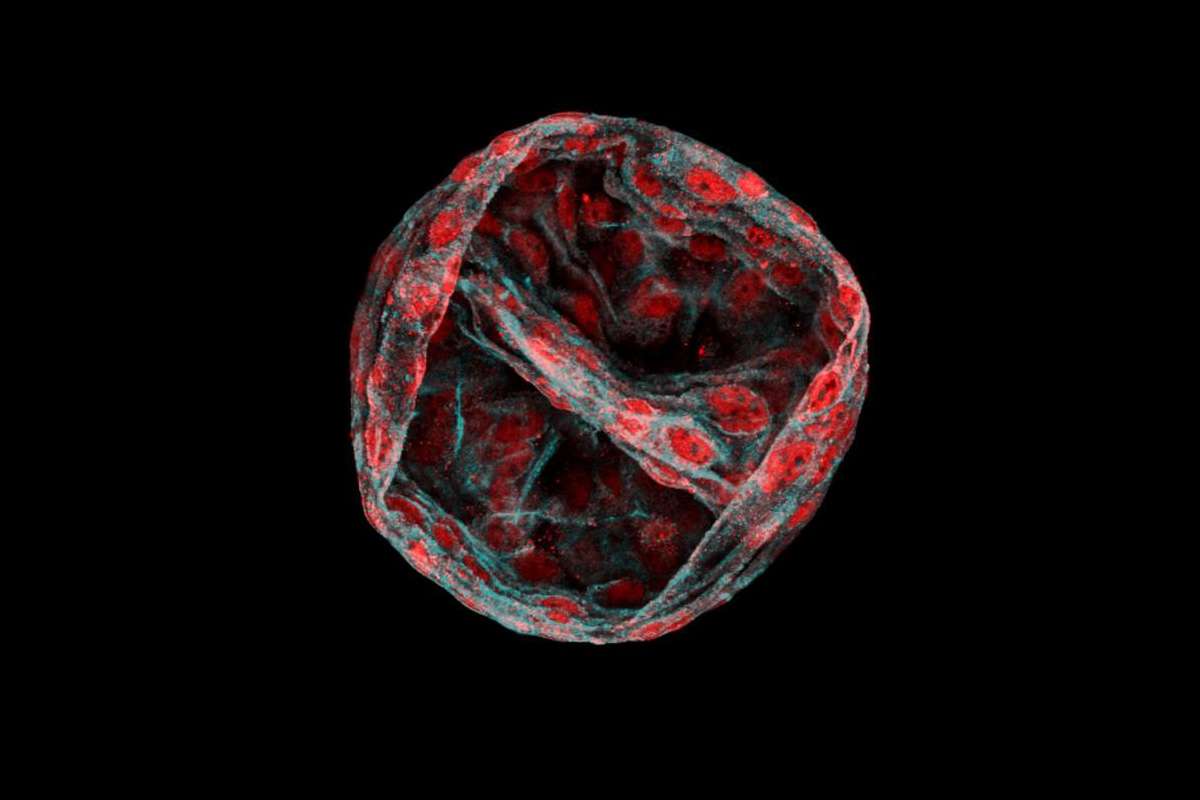
An organoid of human pluripotent colon cells showing MTHFD2 stained in red. Credit: Natalia Pardo Lorente/ Centro de Regulación Genómica. CC BY.
Metabolic enzymes have ‘second jobs’ and researchers have used the discovery to create a new line of attack for cancer.
Researchers at the Centre for Genomic Regulation (CRG) have revealed that metabolic enzymes known for their roles in energy production and nucleotide synthesis are taking on unexpected ‘second jobs’ within the nucleus, orchestrating critical functions like cell division and DNA repair.
The discovery, published in two papers, not only challenges longstanding biological paradigms in cellular biology but also opens new avenues for cancer therapies, particularly against aggressive tumours like triple-negative breast cancer (TNBC).
For decades, biology textbooks have neatly compartmentalised cellular functions.
Mitochondria are the powerhouses of the cell, the cytoplasm is a bustling factory floor for protein synthesis, and the nucleus a custodian of genetic information.
However, Dr Sara Sdelci and her team at the CRG have discovered that the boundaries between these cellular compartments are less defined than previously thought.
Lead author of both papers, Sdelci said: “Metabolic enzymes are moonlighting outside of their traditional neighbourhood.
“It’s like discovering your local baker is also a brewer in the next town over.
“There’s an overlap in the skillset, but they’re doing entirely different jobs for entirely different purposes.”
She added: “Surprisingly, their secondary roles in the nucleus are just as critical as their primary metabolic functions. It’s a new layer of complexity that we hadn’t appreciated before.”
Pivotal role
In one of the studies, researcher Dr Natalia Pardo Lorente focused on the metabolic enzyme MTHFD2.
Traditionally, MTHFD2 is found in the mitochondria, where it plays a key role in synthesising the building blocks of life and contributing to cell growth.
Pardo Lorente’s work reveals that MTHFD2 also moonlights within the nucleus, where it plays a pivotal role in ensuring proper cell division.
The study is the first to demonstrate that the nucleus relies on metabolic pathways to maintain the integrity and stability of the human genome.
Pardo Lorente said: “Our finding fundamentally alters our understanding of how cells are organised. The nucleus isn’t just a passive storage space for DNA; it has its own metabolic needs and processes.”
Most aggressive
In the second study, researchers Dr Marta García-Cao and Dr Lorena Espinar turned their attention to triple-negative breast cancer, the most aggressive type of breast cancer there is.
The disease is responsible for around one in eight breast cancer diagnoses and amounts to roughly 200,000 new cases each year worldwide.
Usually, excessive DNA damage triggers cell death. However, TNBC has a propensity to accumulate DNA damage without consequence, making it resilient to conventional treatments.
The study helps partly explain why: the metabolic enzyme IMPDH2 relocates to the nucleus of TNBC cells to assist in DNA repair processes.
García-Cao said: “IMPDH2 acts like a mechanic in the cell’s nucleus, controlling the DNA damage response that would otherwise kill the cancer cell.”
By experimentally manipulating IMPDH2 levels, the team found they could tip the balance.
Increasing IMPDH2 within the nucleus overwhelmed the cancer cells’ repair machinery, causing cells to self-destruct.
Espinar said: “It’s like overloading a sinking ship with more water — eventually, it sinks faster.”
Their approach effectively forces TNBC cells to succumb to the very DNA damage they are typically resilient to.
Monitoring cancer
The study can also lead to new ways of monitoring cancer. The research on IMPDH2 also studied its interaction with PARP1, a protein already targeted by existing cancer drugs.
García-Cao said: “IMPDH2 could serve as a biomarker to predict which tumours will respond to PARP1 inhibitors.”
Both studies contribute to an emerging field of therapies targeting cancer by exploiting its metabolic vulnerabilities.
Sdelci said: “Metabolic enzymes are an entirely new class of therapeutic targets for us to exploit.
“It paves the way for a two-pronged attack against cancer cells: disrupting their energy production while simultaneously impairing their ability to repair DNA and divide properly.
“Combining this strategy with conventional treatments could give cancer less room to adapt and help tackle the usual mechanisms of drug resistance.”
While the concept of enzymes having multiple roles within a cell is not entirely new, the studies show the extent and significance of these ‘second jobs’ are only beginning to be appreciated.
Pardo Lorente said: “This is a paradigm shift and there might be many more moonlighting metabolic enzymes yet to be found.
“The cell is more interconnected than we thought, and that opens up exciting possibilities for science and medicine.”
The two papers are published in Nature Communications.


