


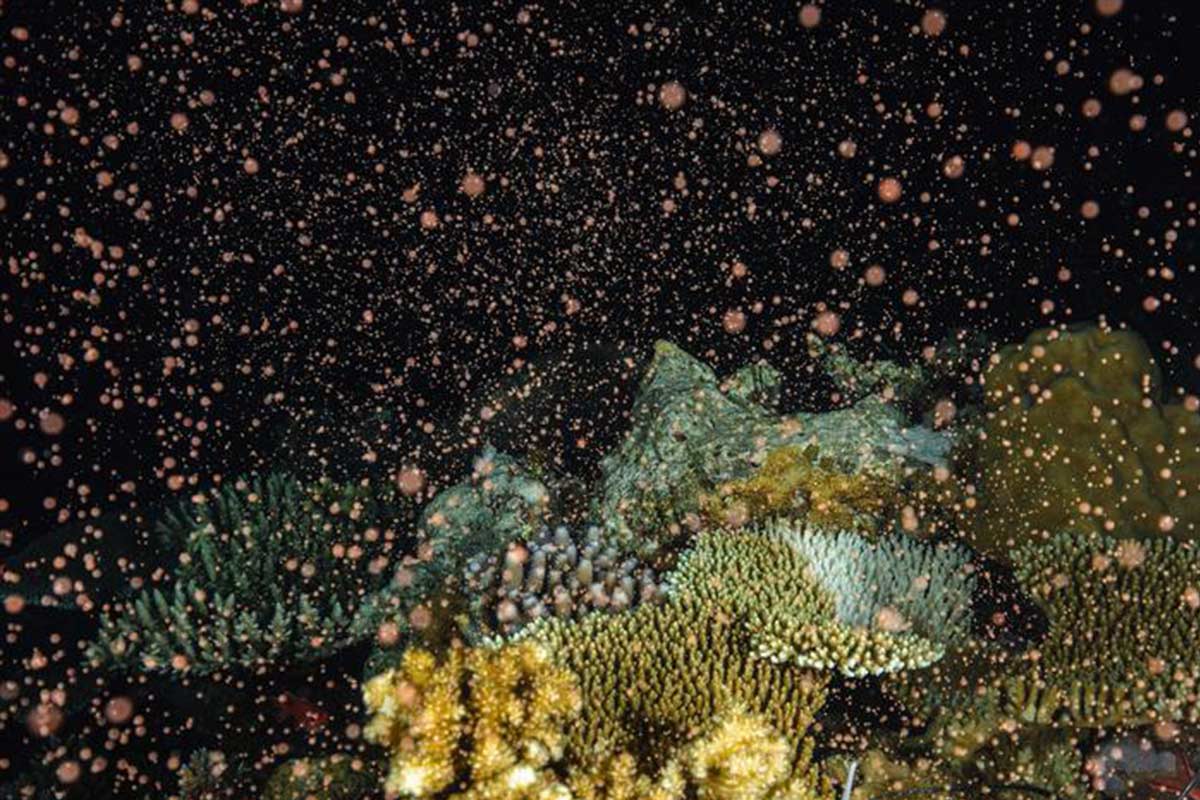
Coral spawning in Palau. Credit: Peter Mumby.
A new study reveals corals must be within only a few metres of each other to successfully reproduce, leaving them vulnerable in a warming world.
The international research, led by The University of Queensland’s Professor Peter Mumby, measured the success of a natural spawning event in March this year.
He said: “In what came as a surprise, we saw that corals needed to be within ten metres of one another, and preferably closer than that for fertilisation to take place.
“We knew corals couldn’t be too far apart, but we found they need to be closer than we’d expected.
“Climate change impacts like bleaching are killing and reducing the density of corals, so we’re concerned that individuals may end up too far apart to reproduce successfully.”
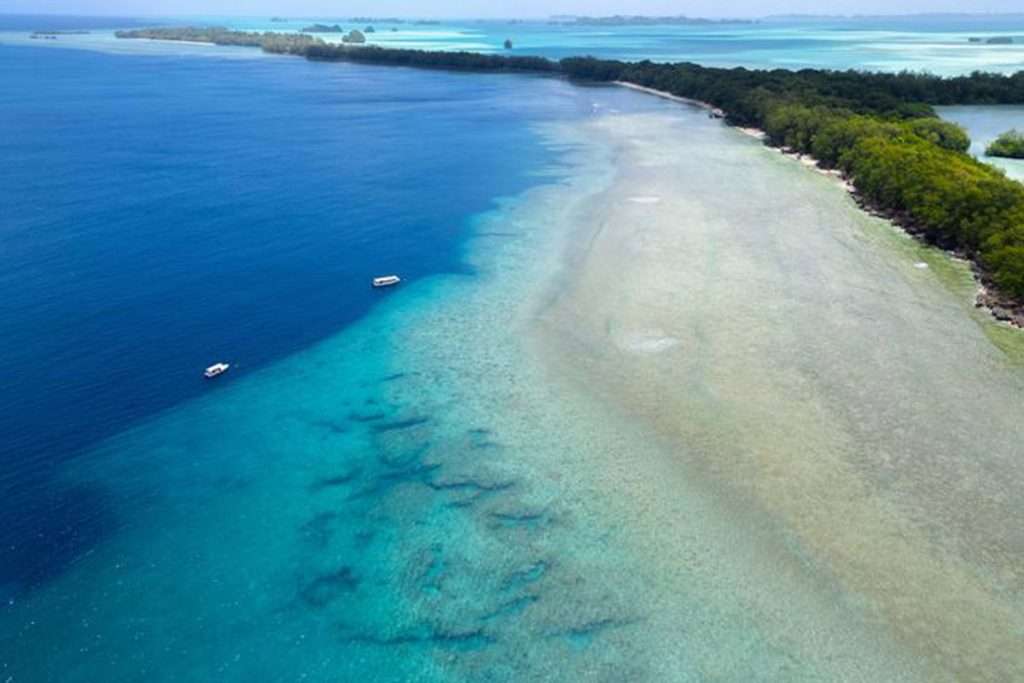
Reef research site in Palau. Credit: Peter Mumby.
Coral colonies
To quantify reproduction success, the team placed containers above 26 coral colonies on a reef in Palau, Micronesia during a time when the mostly hermaphroditic corals released eggs and sperm.
Mumby said: “The containers captured some of each corals’ eggs and drifted to the surface where they followed the tide.
“Although the eggs could not escape, sperm could enter the container and fertilise the eggs.
“After an hour of drifting, the proportion of fertilised eggs was noted for each type of coral along with the distance to similar established corals.”
Drop off
Fertilisation averaged 30% when corals were very close, but it declined to less than 10% at a separation of ten metres and was virtually zero by 20m.
Co-author Dr Christopher Doropoulos of the CSIRO, Australia’s national science agency, said coral reproduction was fundamental to population resilience and evolution: “In the future we may need to help corals continue this key part of their lives.
“Understanding the importance of local neighbourhoods provides tangible targets for interventions like coral restoration.
“Ideally, the density of corals would be monitored at important locations and restoration carried out to return the density back to the levels required for successful reproduction.”
Critical thresholds
Mumby has been working on efforts to repair damaged coral reefs.
He said: “Our work over the past five years on the Great Barrier Reef through the Reef Restoration and Adaptation Program is also helping to define these critical thresholds to help restoration practitioners set targets for density to help maintain coral populations.”
The study is published in the Proceedings of the National Academy of Sciences USA (PNAS).


