


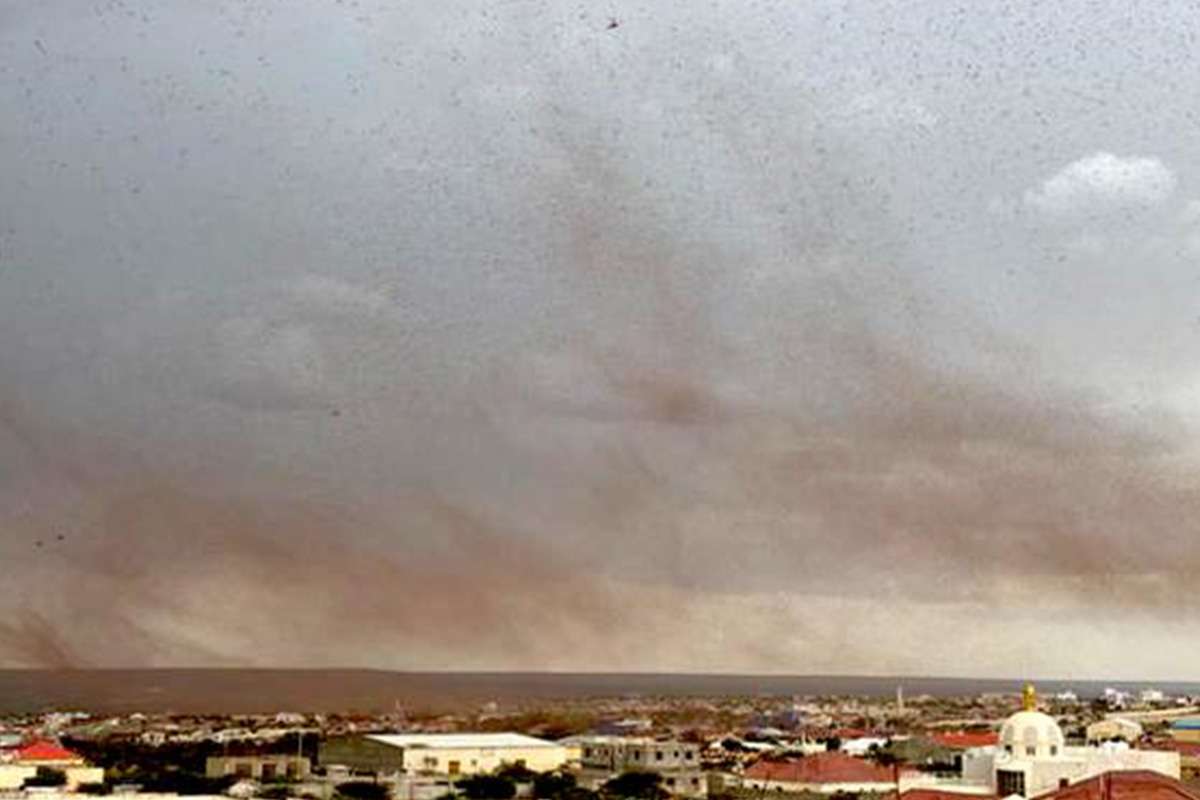
This migratory pest can reach plague proportions, and a swarm covering one square kilometre can consume enough food in one day to feed 35,000 people. Credit: Keith Cressman, FAO.
A new early warning tool developed by a University of Cambridge-led team, will help control huge locust swarms.
Desert locusts typically lead solitary lives until something – like intense rainfall – triggers them to swarm in vast numbers, often with devastating consequences.
This migratory pest can reach plague proportions, and a swarm covering one square kilometre can consume enough food in one day to feed 35,000 people.
Such extensive crop destruction pushes up local food prices and can lead to riots and mass starvation.
Now a team led by the University of Cambridge has developed a way to predict when and where desert locusts will swarm, so they can be dealt with before the problem gets out of hand.
It uses weather forecast data from the UK Met Office, and state-of the-art computational models of the insects’ movements in the air, to predict where swarms will go as they search for new feeding and breeding grounds. The areas likely to be affected can then be sprayed with pesticides.
Until now, predicting and controlling locust swarms has been ‘hit and miss’, according to the researchers. Their new model will enable national agencies to respond quickly to a developing locust threat.
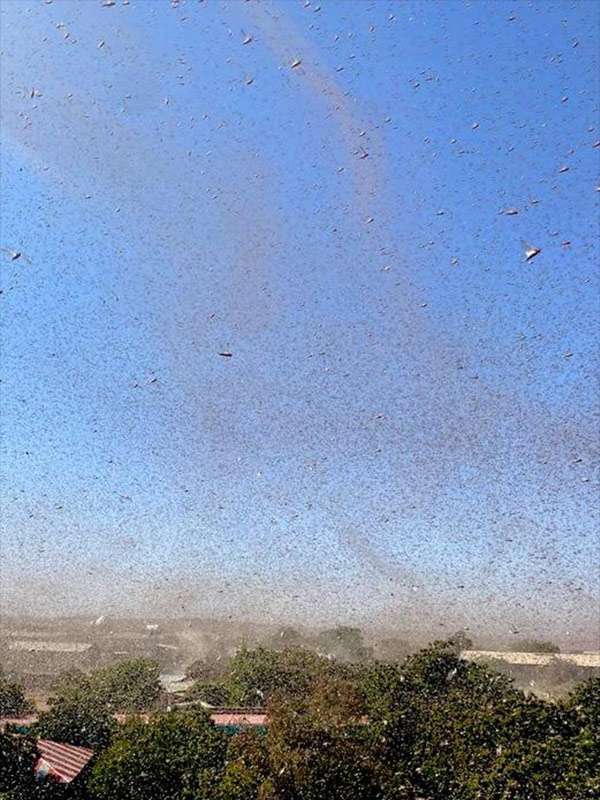
A team led by the University of Cambridge has developed a way to predict when and where desert locusts will swarm, so they can be dealt with before the problem gets out of hand. Credit: Keith Cressman, FAO.
Top priority
Desert locust control is a top priority for food security: it is the biggest migratory pest for smallholder farmers in many regions of Africa and Asia, and capable of long-distance travel across national boundaries.
Climate change is expected to drive more frequent desert locust swarms, by causing trigger events like cyclones and intense rainfall.
These bring moisture to desert regions that allows plants to thrive, providing food for locusts that triggers their breeding.
First author of the paper, Dr Renata Retkute, a researcher in the University of Cambridge’s Department of Plant Sciences, said: “During a desert locust outbreak we can now predict where swarms will go several days in advance, so we can control them at particular sites.
“And if they’re not controlled at those sites, we can predict where they’ll go next so preparations can be made there.”
Senior author Professor Chris Gilligan in the University of Cambridge’s Department of Plant Sciences, said: “The important thing is to respond quickly if there’s likely to be a big locust upsurge, before it causes a major crop loss. Huge swarms can lead to really desperate situations where people could starve.
“Our model will allow us to hit the ground running in future, rather than starting from scratch as has historically been the case.”
Infestations
The team noticed the need for a comprehensive model of desert locust behaviour during the response to a massive upsurge over 2019-2021, which extended from Kenya to India and put huge strain on wheat production in these regions.
The infestations destroyed sugarcane, sorghum, maize and root crops. The researchers say the scientific response was hampered by the need to gather and integrate information from a range of disparate sources.
Retkute said: “The response to the last locust upsurge was very ad hoc, and less efficient than it could have been.
“We’ve created a comprehensive model that can be used next time to control this devastating pest.”
Although models like this have been attempted before, this is the first that can rapidly and reliably predict swarm behaviour.
It takes into account the insects’ lifecycle and their selection of breeding sites, and can forecast locust swarm movements both short and long-term.
The new model has been rigorously tested using real surveillance and weather data from the last major locust upsurge.
It will inform surveillance, early warning, and management of desert locust swarms by national governments, and international organisations like the Food and Agriculture Organization of the United Nations (FAO).
The researchers say countries that haven’t experienced a locust upsurge in many years are often ill-prepared to respond, lacking the necessary surveillance teams, aircraft and pesticides.
As climate change alters the movement and spread of major swarms, better planning is needed – making the new model a timely development.
The research is published in PLOS Computational Biology.


