


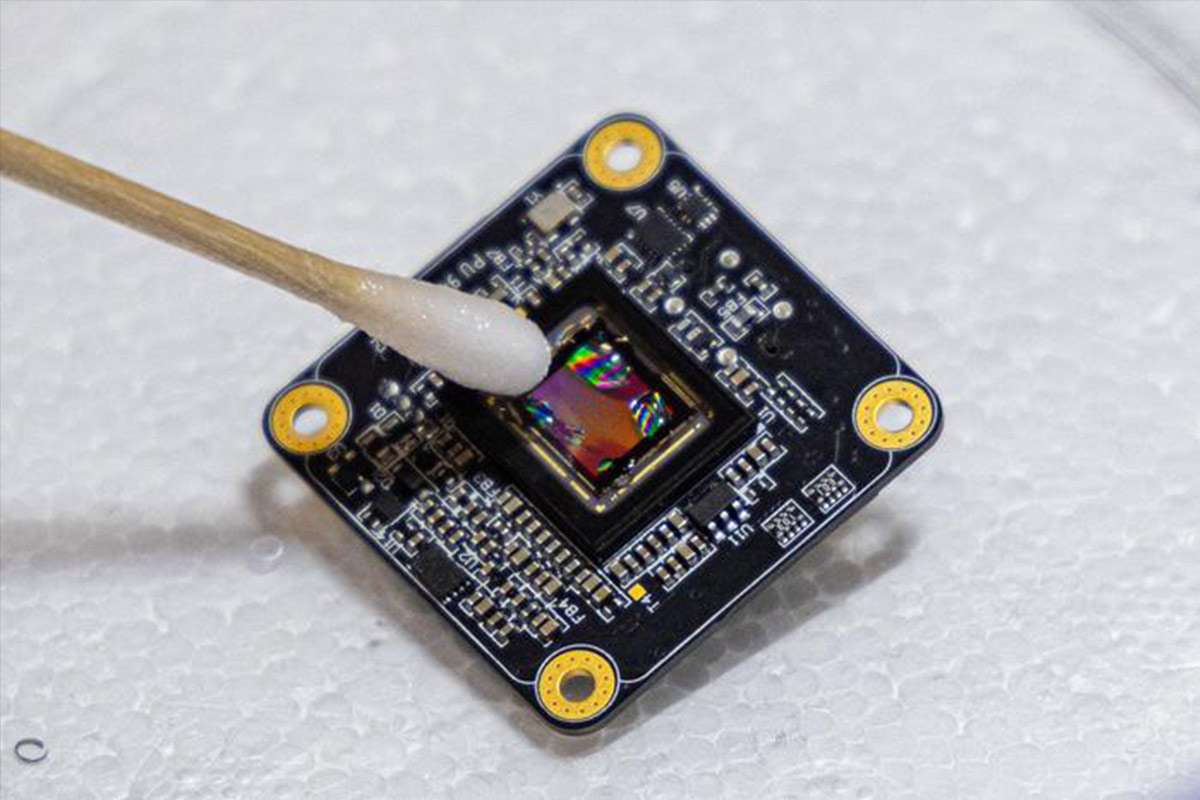
The DeepInMiniMicroscope developed by UC Davis electrical engineering professor Weijian Yang combines optical technology and machine learning to create a device that can take high-resolution three-dimensional images inside living tissue. Credit: Mario Rodriguez/ UC Davis.
Researchers have created a miniaturised microscope for real-time, high-resolution, non-invasive imaging of brain activity in mice.
The device is a significant step toward revolutionising how neuroscientists study the brain.
Weijian Yang, professor of electrical and computer engineering at the University of California, Davis, said: “What we are doing is creating technology to image brain activity in freely moving and behaving mice to open up the behaviour paradigm.
“The goal is to create a device capable of enabling research into brain activity and behaviour in mice in real time — to see how brain activity drives behaviour or perception.”
The microscope will advance insights into how the brain works, which is expected to benefit human health by empowering the development of new and improved therapeutic strategies for brain disorders.
The first-of-its-kind imaging system is known as DeepInMiniscope.
Iterative design
DeepInMiniscope builds on Yang’s previous work to create a lensless camera capable of producing three-dimensional images from a single exposure.
This imaging system was well-suited for large objects in environments with minimal light scattering, such as robotic vision for part assembly, but struggled to capture the details of biological or biomedical samples.
In living tissue, light scattering is prevalent, signal contrast tends to be low and reconstructing intricate features across a large volume of space is a computational problem.
DeepInMiniscope solves these issues with a new mask design containing more than 100 miniaturised, high-resolution lenslets.
A novel neural network combines images from each lenslet to reconstruct images in 3D.
Deep (learning) insights
DeepInMiniscope’s neural network combines different approaches to machine learning to create an unrolled neural network, which allows for instantaneous, accurate and high-resolution reconstruction of fine details across a large 3D volume.
Using this tool, Yang and his research team have recorded a mouse’s neuronal activity in real time.
Feng Tian, a postdoctoral researcher in Yang’s lab and first author on the corresponding paper, said: “Our algorithm combines interpretability, efficiency, scalability and precision.
“It requires only a minimal amount of training data, yet it can robustly and accurately process large-scale datasets at high speed.”
Hat trick
By making his microscope small and ergonomic enough for a mouse to comfortably and safely wear as it moves freely, Yang aims to enable neuroscientists to study behaviour in real time.
At just 3cm2, about the size of a grape, and around the weight of four pennies at 10 grams, DeepInMiniscope is nearly there.
Where earlier, similar designs were constrained by the large footprint of a traditional camera, DeepInMiniscope uses a sensor as compact as a bare circuit board with an image sensor, rather than a self-contained and enclosed system.
Yang’s ultimate goal is a 2cm2 device, which he compares to the size of a hat for a mouse.
Additionally, for the next iteration, Yang wants to make the device cordless: “By enabling real-time observation of brain activity in freely behaving mice, this technology not only advances our fundamental understanding of how the brain processes information and drives behaviour, but also contributes to improving our understanding of brain disorders and the development of future therapeutic strategies in humans.”
The research is published in Science Advances.


