


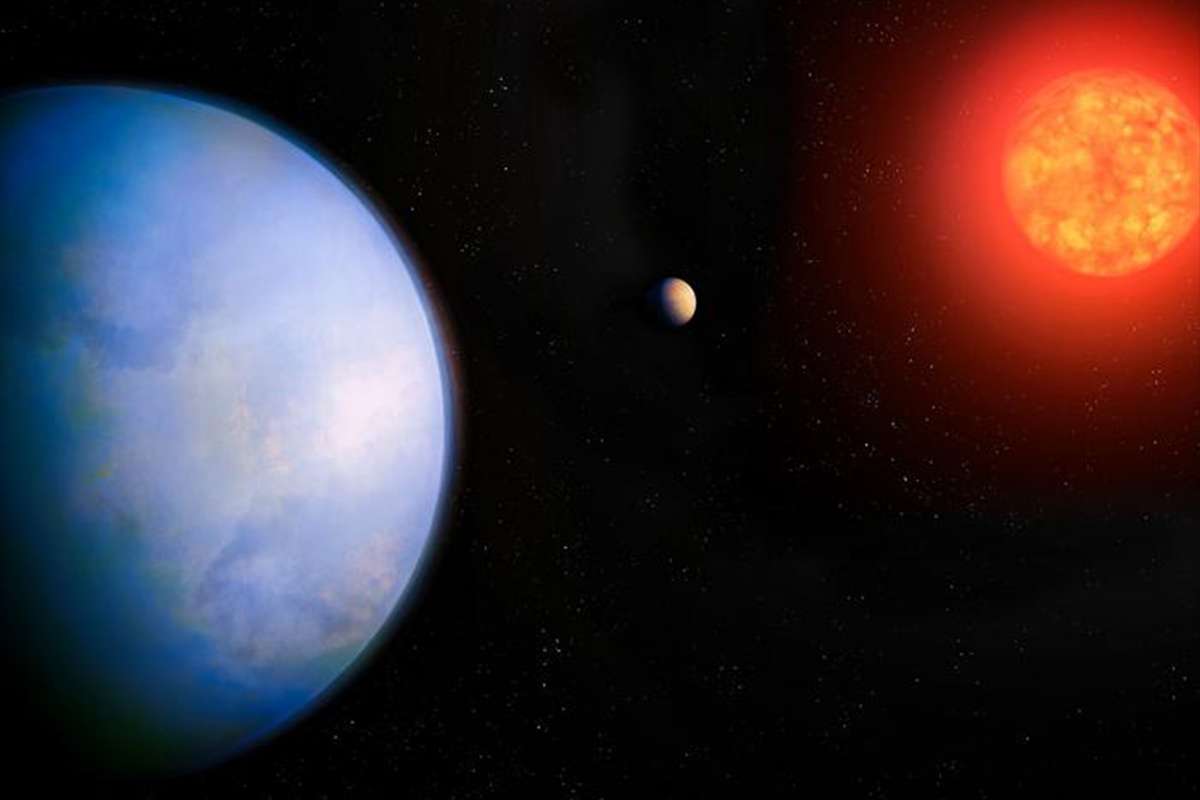
An international team of scientists, including researchers at Penn State, dubbed the exoplanet, named GJ 251 c, a “super-Earth” as data suggest it has a rocky composition similar to Earth and is almost four times as massive. Credit: Illustration by University of California Irvine. CC BY-NC-ND.
A massive ‘super-Earth’ discovered orbiting a nearby dwarf star is well positioned for next-generation telescopes to search for signs of life.
The discovery of a possible super-Earth less than 20 light-years from our own planet is offering scientists new hope in the hunt for other worlds that could harbour life, according to an international team including researchers from Penn State.
They dubbed the exoplanet, named GJ 251 c, a ‘super-Earth’ as data suggest it is almost four times as massive as the Earth, and likely to be rocky planet.
Suvrath Mahadevan, the Verne M Willaman Professor of Astronomy at Penn State and co-author on a paper about the discovery, said: “We look for these types of planets because they are our best chance at finding life elsewhere.
“The exoplanet is in the habitable or the ‘Goldilocks Zone,’ the right distance from its star that liquid water could exist on its surface, if it has the right atmosphere.”
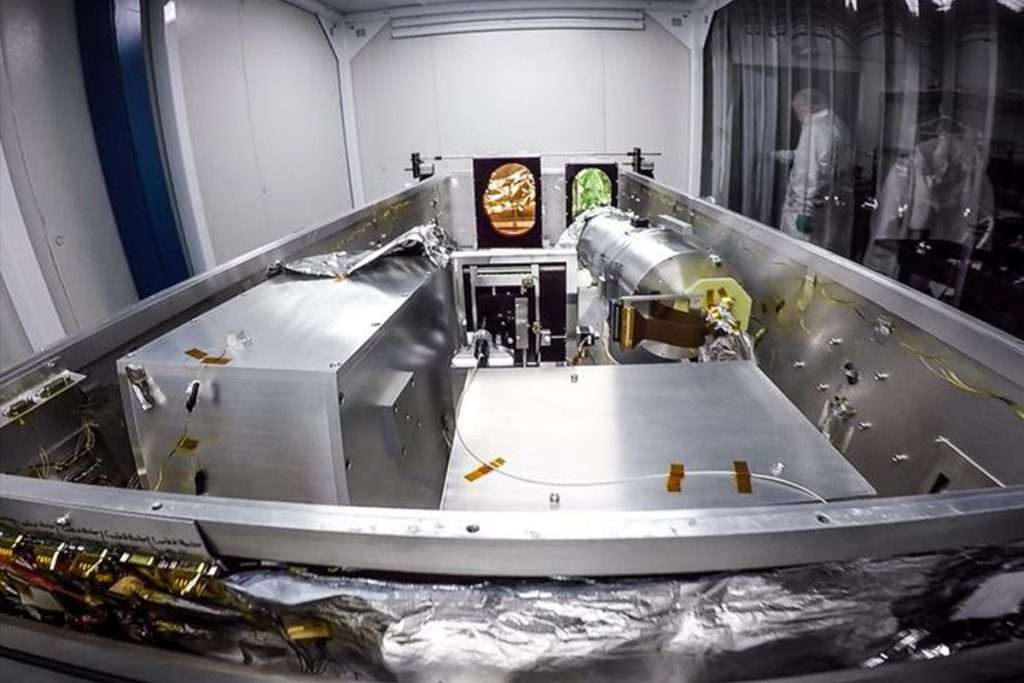
The Penn State-led Habitable Zone Planet Finder (HPF) provides the highest precision measurements to date of infrared signals from nearby stars. Pictured: The HPF instrument during installation in its clean-room enclosure in the Hobby Eberly Telescope at McDonald Observatory. Credit: Guðmundur Stefánssonn/ Penn State. CC BY-NC-ND.
Habitable-Zone Planet Finder
For decades, the search for planets that might host liquid water, and perhaps life, has driven astronomers to design and construct advanced telescopes and computational models capable of detecting even the faintest signals from starlight.
This latest discovery was the result of two decades of observational data and offers one of the most promising prospects yet for searching for signs of life on other planets, Mahadevan said.
The exoplanet was found using data from the Habitable-Zone Planet Finder (HPF), a high-precision, near-infrared spectrograph — a complex prism that breaks apart signals from starlight — fixed to the Hobby-Eberly Telescope at the McDonald Observatory in Texas.
Penn State researchers led the design and construction of the HPF, built to detect Earth-like planets in the habitable zones of nearby stars.
Mahadevan said: “We call it the Habitable Zone Planet Finder, because we are looking for worlds that are at the right distance from their star that liquid water could exist on their surface. This has been the central goal of that survey.
“This discovery represents one of the best candidates in the search for atmospheric signature of life elsewhere in the next five to ten years.”
Wobble
Mahadevan and his colleagues made the discovery by analysing a vast collection of data, spanning over 20 years and collected by telescopes around the world, focusing on the slight movement, or ‘wobble’, of the planet’s host star, GJ 251.
This wobble comprises tiny Doppler shifts in the star’s light caused by an orbiting planet’s gravity.
They used the baseline observations to first improve the wobble measurements of a previously known inner planet, GJ 251 b, which circles the star every 14 days.
They then combined the baseline data with new high-precision data from the HPF to reveal a second, stronger signal at 54 days — indicating there was another, far more massive, planet in the system.
The team further confirmed the planet’s signal using the NEID spectrometer built by Penn State researchers, which is attached to a telescope at the Kitt Peak National Observatory in Arizona.
Corey Beard, corresponding author on the paper who conducted the research while earning a doctorate in astrophysics from the University of California, Irvine, said: “We are at the cutting edge of technology and analysis methods with this system.
“We need the next generation of telescopes to directly image this candidate, but what we also need is community investment.”
Challenge
One of the biggest challenges in finding distant worlds is disentangling the planetary signal from its star’s own activity, a kind of stellar weather, Mahadevan explained.
Stellar activity, such as starspots, can mimic the periodic motion of a planet, giving the false impression of a planet where there is none.
To distinguish signal from noise, the researchers applied advanced computational modelling techniques to analyse how signals change across different wavelengths, or colours, of light.
Mahadevan said: “This is a hard game in terms of trying to beat down stellar activity as well as measuring its subtle signals, teasing out slight signals from what is essentially this frothing, magnetospheric cauldron of a star surface.”
He explained that discovering exoplanets like GJ 251 c requires advanced instruments and complex data analysis.
The work involves collaborations across multiple institutions and expertise throughout the world, and most importantly, requires a sustained commitment from the countries funding the research — which can often take decades to yield actionable results.
Eric Ford, distinguished professor astronomy and astrophysics and director of research for Penn State’s Institute of Computational & Data Sciences (ICDS), said: “This discovery is a great example of the power of multi-disciplinary research at Penn State.
“Mitigating stellar activity noise required not just cutting-edge instrumentation and telescope access, but also customising the data science methods for the specific needs of this star and combination of instruments.
“The combination of exquisite data and state-of-the art statistical methods enabled our interdisciplinary team to transform data into an exciting discovery that paves the way for future observatories to search for evidence of life beyond our solar system.”
While the exoplanet that the team discovered is not possible to image with current instruments Mahadevan said, the next generation of telescopes would be able analyse the planet’s atmosphere, which could potentially reveal chemical signs of life.
He said: “We are always focused on the future, whether that’s making sure the next generation of students can engage in cutting-edge research or designing and building new technology to detect potentially habitable planets.”
The study is published in The Astronomical Journal.


