


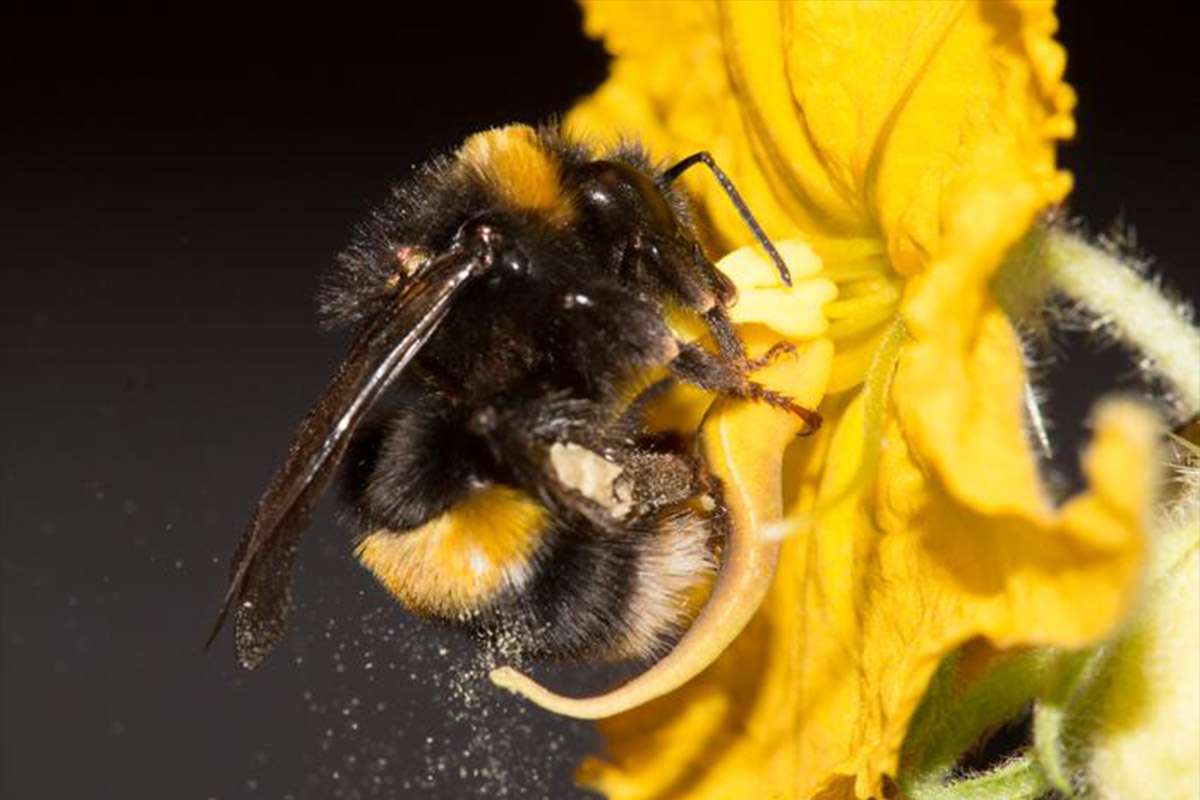
A buff-tailed bumblebee (Bombus terrestris) buzz-pollinating a flower of the tomato family. Credit: Mario Vallejo-Marin. CC BY-NC-ND.
High temperatures and exposure to heavy metals is having an impact on the way that bees buzz, which could impact their ability as pollinators.
Ongoing research into the effect of environmental change on the buzzing of bees reveals that high temperatures and exposure to heavy metals reduces the frequency (and audible pitch) of non-flight wing vibrations, which could have consequences on the effectiveness of bee communication and their role as pollinators.
Dr Charlie Woodrow, a post-doctoral researcher at Uppsala University, said: “People have been long interested in how insect flight muscles work, as these muscles power the most efficient flight systems in nature.
“However, many do not know that bees use these muscles for functions other than flight.”
These important non-flight muscle vibrations are used in communication, defence and buzz-pollination.
Woodrow explained: “Buzz pollination is an incredible behaviour whereby a bee will curl its body around the pollen-concealing anthers of some flowers, and contract the flight muscles up to 400 times per second to produce vibrations which shake the pollen loose.
“We want to understand how variation in these vibrations affects pollen release, to understand plant reproduction and pollinator behaviour.
“This inspired us to research how non-flight buzzes differ within and between species, and the drivers affecting these buzzes.”
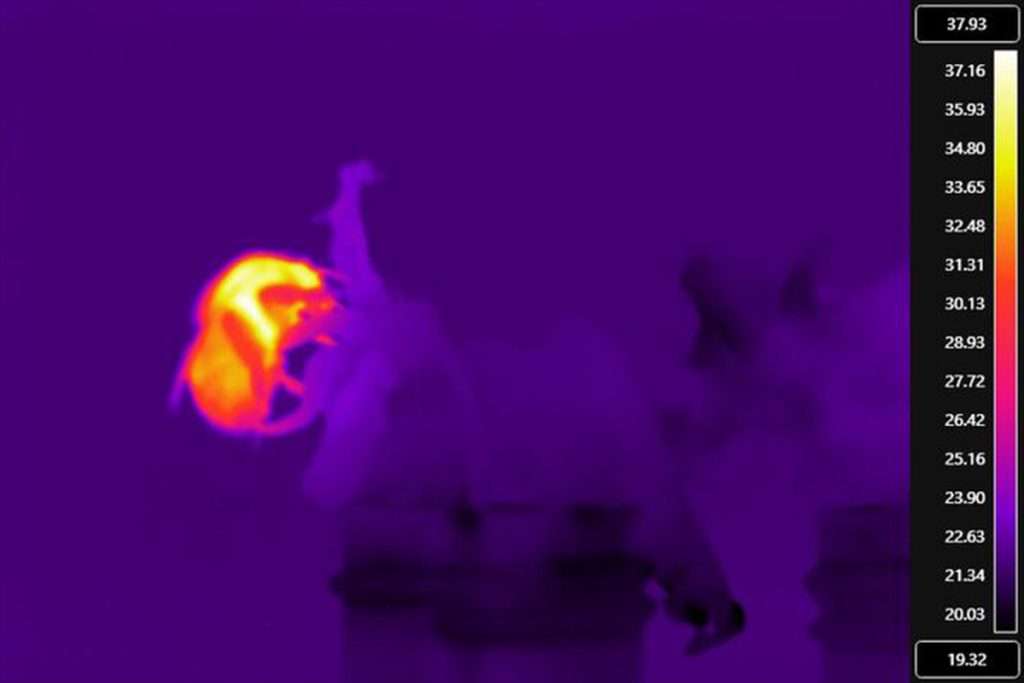
During buzz-pollination, the buff-tailed bumblebee (Bombus terrestris) reaches body temperatures of almost 40°C. Charlie Woodrow. CC BY-NC-ND.
Vibrations
Woodrow’s experiments were carried out using colonies of buff-tailed bumblebees (Bombus terrestris), a common European species that are well studied.
Using accelerometers, Woodrow and his team were able to measure the frequency of the buzz, which corresponds to the audible pitch.
He said: “They are super easy to use in the field. We press these against the thorax of the bee, or against the flower the bee is visiting, and we can record the vibrations the bee produces.”
Woodrow and his team also coupled the accelerometry with thermal imaging, which shows them how bees deal with the extra heat that they generate when buzzing.
“We have also been using high-speed filming to uncover never before seen behaviours. For example, we recently discovered that bees don’t just vibrate on flowers, but they periodically transmit these vibrations to flowers by biting.”
He explained: “We have recently found that temperature plays a vital role, much more than was previously appreciated, and this work is currently in review for publication.
“This has many implications for how we study buzz-pollination, as temperature is not really something that has been considered up to this point.”
Exposure to heavy metals
As well as increased temperatures, exposure to heavy metals was also shown to reduce the contraction frequencies of the flight muscles during non-flight buzzing, which Woodrow is working on in collaboration with Dr Sarah Scott at Newcastle University, UK.
However, the researchers were surprised to find no differences in the effect of temperature on buzzing when the experiments were reproduced in the Arctic compared to those further south, suggesting underlying muscle physiology, rather than local adaptation, may be responsible for determining the properties of a bee’s buzz.
The benefits of understanding the impact of environmental change on a bee’s buzz include unique insights into bee ecology and behaviour, helping to identify the species or regions most at risk, and the improvement of AI-based species detection based on sound recordings.
Woodrow said: “Perhaps buzzes could even be used as a marker of stress or environmental change? For example, we now know that certain environmental pollutants can affect the buzzes bees produce, so they could even serve as an indicator of ecosystem health.”
He added: “It is important we understand how these changes will affect non-flight buzzes because they are responsible for so many aspects of a bee’s ecology.
“If these vibrations are disrupted, this could lead to poor communication in the colony, inefficient thermoregulation, or poor resource acquisition for their offspring.”
Serious consequences
Perhaps most concerningly for humans and wildlife alike, a reduction in buzz-pollination could have potentially serious consequences for plant reproduction and biodiversity.
Woodrow said: “Buzz-pollination is energetically expensive and causes the bee to generate metabolic heat – therefore if the environment gets too warm, it may simply choose to avoid buzz-pollinated flowers.”
As well as furthering our understanding of how environmental change may be affecting bee buzzes, there are also applications for robotics and the future safeguarding of pollination services.
Woodrow said: “We are working towards understanding bee vibrations through micro-robotics, so our results are also going towards developing micro-robots to understand pollen release.”
The research is to be presented at the Society for Experimental Biology Annual Conference in Antwerp, Belgium on the 8th July 2025.


