


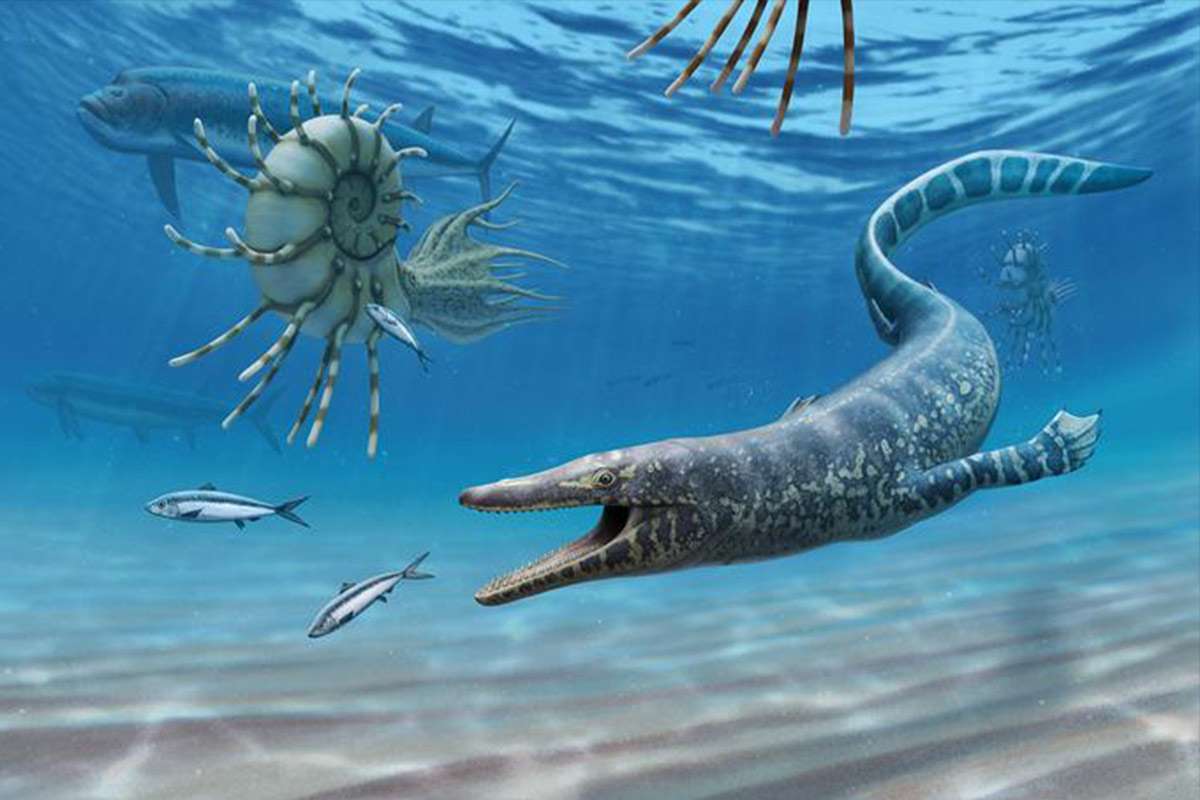
Sarabosaurus dahli life reconstruction. Credit: Andrey Atuchin.
New insights into the evolution and paleoecology of mosasaurs show that these iconic extinct marine lizards continue to surprise.
Mosasaurs are extinct marine lizards, spectacular examples of which were first discovered in 1766 near Maastricht in the Netherlands, fuelling the rise of the field of vertebrate palaeontology (the study of fossil remains of animals with backbones).
Palaeontologist Michael Polcyn has presented the most comprehensive study to date on the early evolution and ecology of these extinct marine reptiles. He will shortly receive his PhD from Utrecht University for his research into the evolution of the mosasaurs.
Polcyn said: “Mosasaurs are a textbook example of macroevolution, the emergence of new and distinct groups of animals, above the level of species.
“Although they have been studied for centuries, new discoveries, novel research approaches, and the application of technology, are still teaching us about their relationships and behaviours, some of which continues to surprise us.
“For example, through the use of detailed comparative anatomy aided by micro-CT scanning technology, we have gained a much better understanding of what group of lizards mosasaurs likely evolved from.”
Additionally, use of these advanced imaging technologies has allowed him to study the internal structures of the braincases of mosasaurs, and sort out the early evolutionary relationships of some previously problematic fossil taxa.
Polcyn continued: “This study not only addressed the early evolution of the group, but also explored small- and large-scale aspects of their feeding biology.
“One spectacular example was a specimen I discovered in Angola, that had the remains of three other mosasaurs in its stomach, one of which was the same taxon as the predator, and documented the first occurrence of cannibalism in mosasaurs.”
To the sea
Mosasaurs belong to a group of lizards that took to the sea about 100 million years ago (just like the ancestors of the whales later did).
Throughout their 34-million-year history, they evolved into well-adapted marine animals that occupied a wide variety of niches and habitats.
Together with a large number of other species, they became extinct 66 million years ago, in the aftermath of the meteorite impact that also wiped out the dinosaurs.
Polcyn said: “A relatively large number of fossils are known from the second half of the evolutionary history of mosasaurs, allowing a good understanding of the relationships among those species, which have been classified into four major groups.
“Much less is known about their early evolutionary history, and how those major groups are related to one another, their origins, and the origin of mosasaurs as a whole.”
To address these gaps, Polcyn has focused on bringing new discoveries to light and restudying historical specimens with advanced imaging technologies, providing significant new anatomical information that is used to infer phylogenetic relationships.
Polcyn’s work helps resolve a long-running scientific debate, concluding mosasaurs are not very closely related to snakes, but supporting the idea that their closest relatives are near the monitor lizards.
You are what you eat
Not much was previously known about the feeding habits of mosasaurs either, but a small, yet no less remarkable gap in that knowledge was filled with the discovery, by Polcyn in Angola, of a fossilised mosasaur with three other mosasaurs in its stomach, one being the same species as the predator.
He said: “Whether that mosasaur was a scavenger or actively hunted its prey cannot be said with certainty; however, we do have the first documented example of cannibalism in mosasaurs.
“Additionally, we gained insights into how mosasaurs processed their prey, and relative body size of prey and predator.”
Also included in his dissertation is a large-scale study of the feeding behaviour of mosasaurs, looking at how mosasaurs divided their foraging areas through the evolutionary history of the group.
Polcyn integrated previously published data, along with a new, very large sample that covered a period from 92 to 66 million years ago and included finds from all over the world. The result of that study illuminate patterns of foraging area segregation, and feeding diversity in mosasaurs.


