


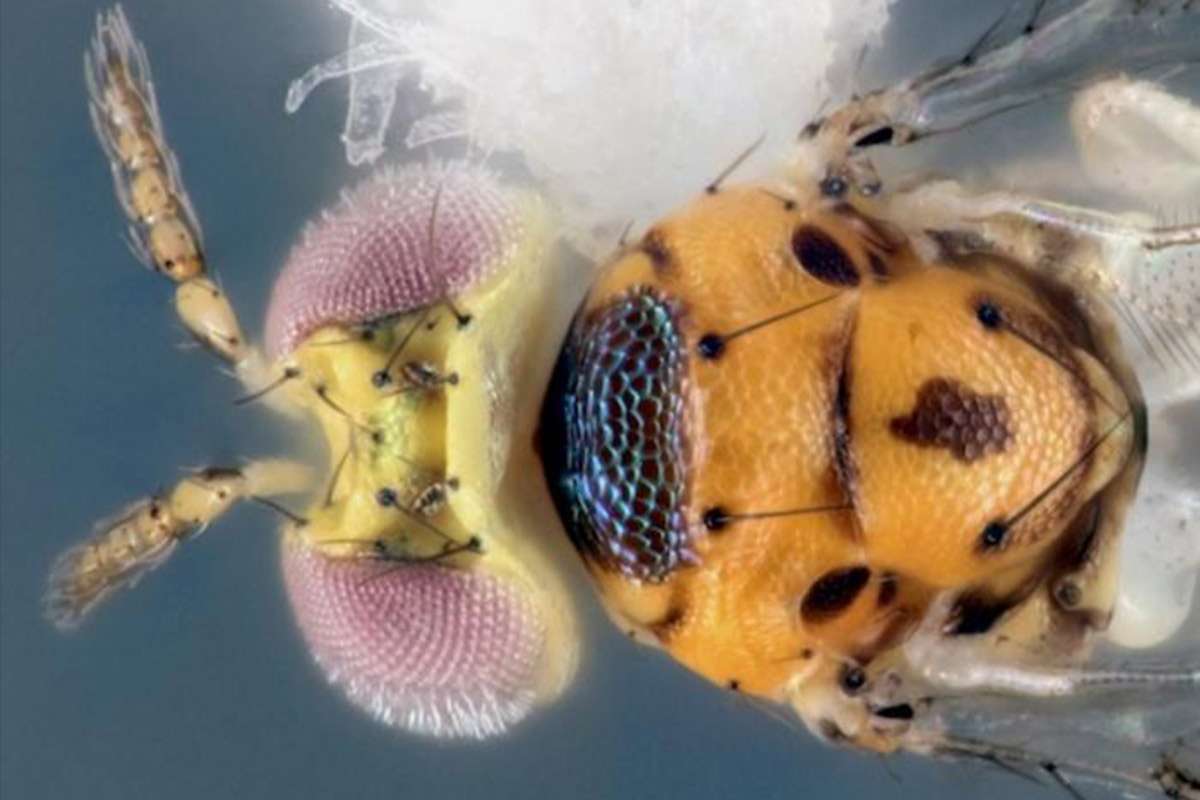
Chrysonotomyia susbelli Credit: Rice University.
A newly identified wasp species, Chrysonotomyia susbelli, has been discovered in Houston, Texas.
The discovery marks 18th new species identified by Rice University’s Scott Egan and his research team since 2014.
The fourth wasp species found on the university grounds in seven years, reveals the hidden world of parasitoid wasps and the intricate ecosystems that thrive outside our doors.
Chrysonotomyia susbelli is a parasitoid wasp, about 1mm long, that emerges from galls, or tumour-like growths created by the gall wasp Neuroterus bussae found on southern live oak leaves. The galls serve as microhabitats within which larvae feed, develop and pupate.
Egan, an associate professor of ecology and evolutionary biology, said: “Chrysonotomyia susbelli represents the sixth species of its genus described from North America and the first globally known to parasitise cynipid gall wasps.”
The wasp was discovered and named by Brendan O’Loughlin, a Rice senior and the study’s first author.
Uniqueness
To confirm the uniqueness of the species, the research team conducted a genetic analysis and a detailed study of the wasp’s physical features under a microscope.
Its investigation also included a review of the historical literature to ensure that the species had not been previously described.
This research was complemented by DNA barcode data and observations of the wasp’s natural history, including host associations and a unique leaf-scanning behaviour exhibited by female wasps.
The researchers also modified the identification key of New World members, groups of species found exclusively in the Americas, to incorporate this new species.
Egan emphasised the importance of studying local biodiversity: “You don’t have to travel to a distant rainforest to find new and beautiful things — you just have to step outside and look.”
The discovery hints at a previously unexplored ecological niche involving Chrysonotomyia parasitoids, cynipid gall wasps, and oaks, suggesting that there may be many more undiscovered species within this system.
Egan concluded: “Generations of Chrysonotomyia susbelli have likely lived unnoticed on the oaks of Rice University since its founding.”
The study is published in the journal ZooKeys.


