


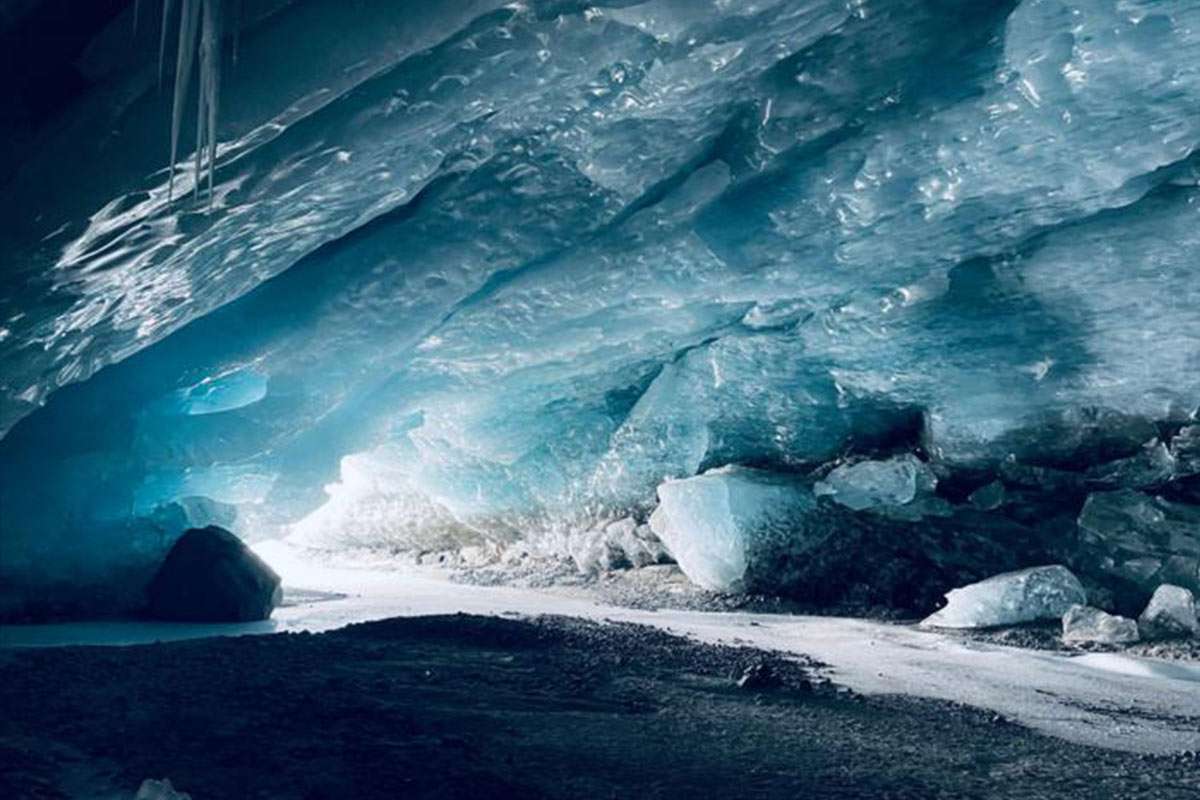
In Switzerland, the Morteratsch-Pers glacier complex is rapidly shrinking. This ice cave, formed in 2023, marks a glacier gate where meltwater emerges. Without decisive climate action, Swiss glaciers could disappear entirely by 2100. Credit: Lander Van Tricht/ ETH Zurich and Vrije Universiteit Brussel.
If global warming can be limited to +1.5°C, it may be possible to preserve twice as much glacier ice than if temperatures rise by +2.7°C.
This conclusion was reached by a research team with participation of ETH Zurich researchers, based on a new, multi-centennial analysis of global glacier evolution.
The findings are striking; even if global temperatures were stabilised at today’s level of 1.2°C, an estimated 39% of global glacier mass would still be lost compared to 2020 levels – contributing over 10cm to global sea-level rise.
In the new study, an international team of 21 scientists from ten countries used eight glacier models to calculate the potential ice loss from more than 200,000 glaciers outside of Greenland and Antarctica.
The team evaluated a wide range of global temperature scenarios, assuming that temperatures would remain constant for thousands of years in each scenario.
Harry Zekollari, co-lead author from Vrije Universiteit Brussel, who began this research as a postdoctoral fellow at the Chair of Glaciology in the Department of Civil, Environmental and Geomatic Engineering (D-BAUG) at ETH Zurich, said: “The choices we make today will resonate for centuries, determining how much of our glaciers can be preserved.”
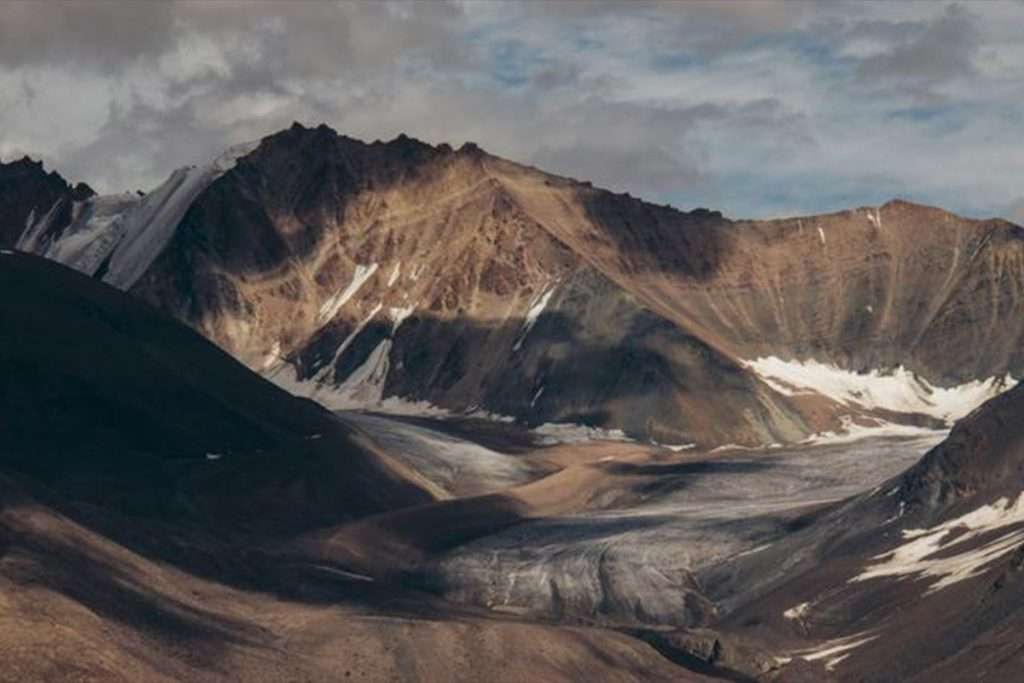
Glacier retreat is a global phenomenon. The Chandran Glacier in India is a striking example of glacial change in Asia. Credit: Alexandra von der Esch/ ETH Zurich.
Looking beyond 2100 reveals new insights
In all scenarios, the glaciers lose mass rapidly over decades and then continue to melt at a slower pace for centuries — even without additional warming.
This long-term response means glaciers will continue to feel the effects of today’s heat far into the future, gradually retreating to higher altitudes before reaching a new equilibrium.
Zekollari said: “One of the key strengths of our study is that we were able, for the first time, to project global glacier evolution over multi-centennial timescales, and did so using eight models instead of one or two.
“Most glacier studies stop at 2100, which is problematic when simulating the long-term impact of today’s climate policies, given the long-term response of glaciers over time.”
For example, while studies limited to the year 2100 estimate that around 20% of today’s glacier mass will be lost regardless of future warming, the new study reveals that nearly twice as much would vanish under present-day conditions when multi-centennial timescales are considered.
Zekollarii said: “We find that around 40% of glacier mass is effectively ‘doomed’ to disappear.”
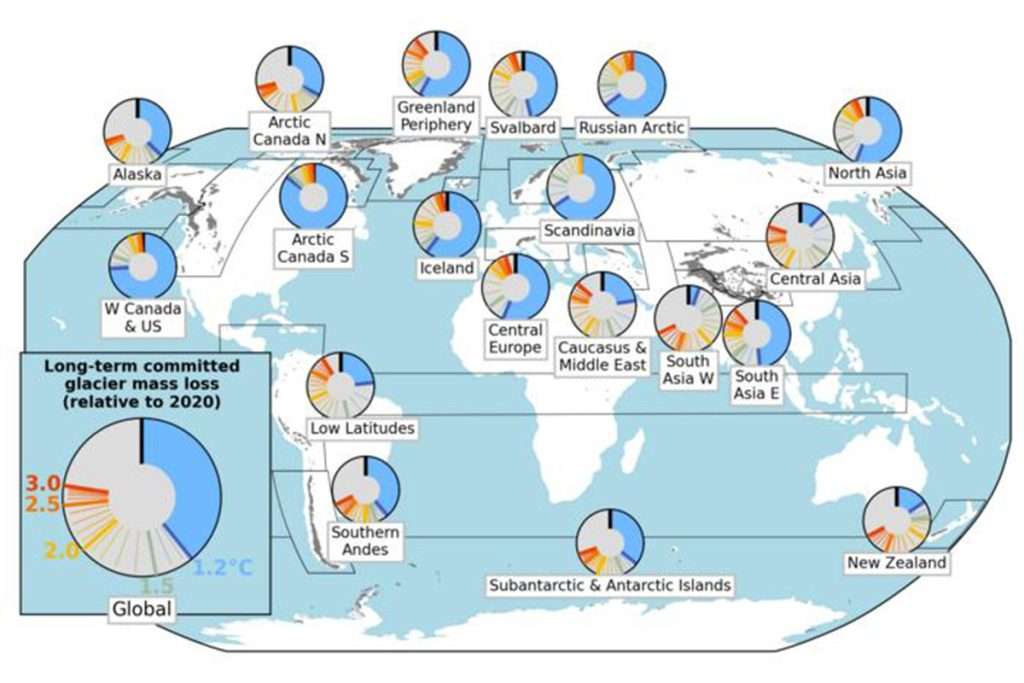
This graph illustrates the loss of glacier mass worldwide as global temperatures rise. It shows that more glaciers – particularly in Asia and New Zealand – could be preserved if global warming is limited to 1.5°C compared to the 2.7°C path resulting from current policies. Each circle represents the proportion of glacier mass projected to be lost even if temperatures remain at today’s level of +1.2°C (blue segment). The coloured lines indicate the additional long-term loss expected if warming continues. Credit: ETH Zurich and Vrije Universiteit Brussel.
Melting glaciers reveal the reality of global warming
Co-lead author Lilian Schuster, from the University of Innsbruck, said: “Glaciers are good indicators of climate change because their retreat allows us to see with our own eyes how climate is changing.
“However, since they adjust over longer timescales, their current size vastly understates the magnitude of climate change that has already happened.
“The situation for glaciers is actually far worse than visible in the mountains today.”
Beyond contributing to sea-level rise, glacier loss has far-reaching consequences; it threatens freshwater availability, increases the risk of glacier-related hazards such as floods and landslides, and jeopardizes glacier-fed tourism economies.
These cascading impacts will be felt across regions and generations.
Zekollari said: “These effects underscore the critical importance of present-day climate policies.
“Our study makes it painfully clear that every fraction of a degree matters – if we manage to limit global warming to +1.5°C instead of +2.7°C, we could still save twice as much glacier ice.”
Current policies are projected to lead to an average global warming of around +2.7°C while the degree of warming between +1.5°C and +3.0°C plays a decisive role in glacier loss.
Put simply: for every additional 0.1°C of warming, the world risks losing approximately 2% more of its glacier ice.
The findings are published in Science.


