


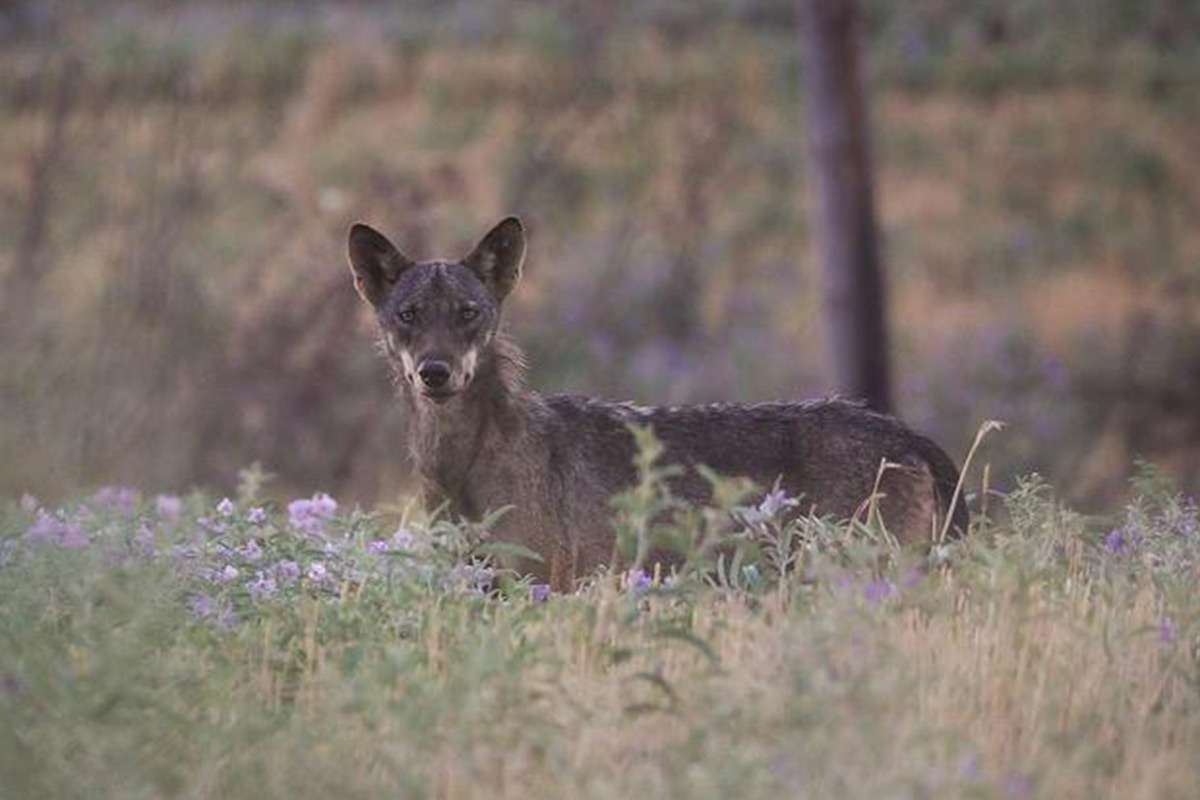
Wolf on agricultural plains in northern Greece. Credit: Seryios Papaioannou, CC-BY 4.0 (https://creativecommons.org/licenses/by/4.0/).
Wolves have made a rapid recovery across Europe according to new research, bucking a trend that sees large carnivores declining worldwide.
Wolf populations in Europe increased by nearly 60% in a decade, according to a study led by Cecilia Di Bernardi and Guillaume Chapron at the Swedish University of Agricultural Sciences.
Large carnivore populations are declining worldwide. However, in Europe, conservation policies have supported the recovery of wolves (Canis lupus) in recent decades.
To understand current trends in their populations, researchers collated data on wolf numbers in 34 countries across Europe.
They found that by 2022, at least 21,500 wolves lived in Europe — an increase of 58% compared to the estimated population of 12,000 a decade earlier.
In most countries analysed, wolf populations were increasing, with only three countries reporting declines over the previous decade.
The researchers also investigated sources of conflict between humans and wolves, such as livestock deaths.
They estimated that in the European Union, wolves killed 56,000 domestic animals per year, out of a total population of 279 million livestock.
Although the risk varied between countries, on average, livestock faced a 0.02% chance of being killed by wolves each year – compensating farmers for these losses cost European countries €17m (~£14.3m) annually.
Extraordinary adaptability
Still, wolves can also have positive economic impacts, such as reducing traffic accidents and damage to forestry plantations by controlling wild deer populations.
However, there wasn’t enough data available to quantify these benefits.
Considering Europe’s large human population and the widespread alteration of landscapes for agriculture, industry and urbanisation, the rapid recovery of wolves over the last decade highlights their extraordinary adaptability.
However, as conservationists transition from saving endangered populations to sustaining a successful recovery, the challenge will be to adapt national and international policies to ensure that humans and wolves can coexist sustainably in the long term, the authors say.
The authors add: “The recovery of wolves across human-dominated landscapes of Europe has been continuing during the past decade, with their population growing to over 21,500 individuals by 2022 – a 58% increase in a decade.
“Ongoing and future challenges include damages directly caused by wolves and broader socio-political issues.”
The study is published in PLOS Sustainability and Transformation.


