


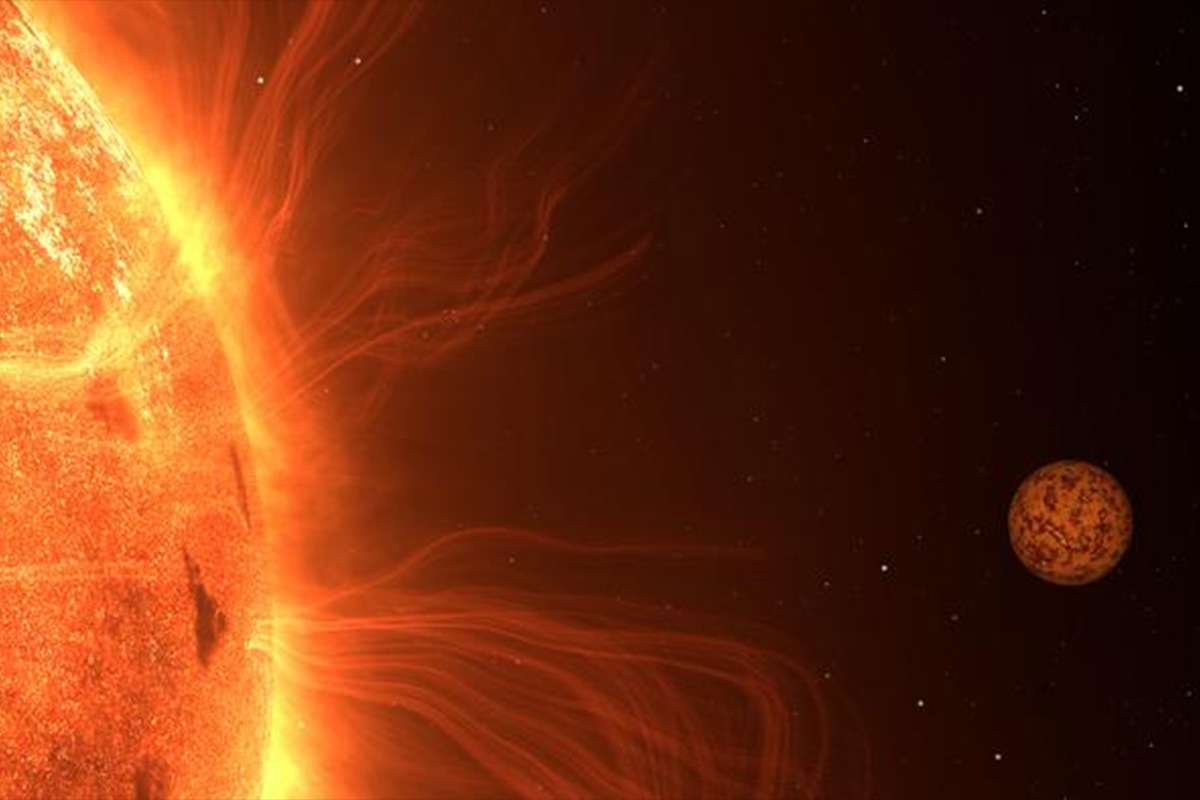
An artistic impression of Trappist-1 b shortly before it passes behind the cool, red dwarf star, Trappist-1. Such stars are known for their activity with large starspots and eruptions. Trappist-1 b may experience intense volcanism. Credit: Thomas Müller (HdA/ MPIA). CC BY-SA.
New observations reveal the challenges of detecting planetary atmospheres, with Trappist-1 b a relatively nearby exoplanet of interest.
Trappist-1 b is one of seven rocky planets orbiting the star Trappist-1, located 40 light-years away.
The planetary system is unique because it allows astronomers to study seven Earth-like planets from relatively close range, with three of them in the so-called habitable zone.
This is the area in a planetary system where a planet could have liquid water on the surface.
To date, ten research programmes have targeted this system with the James Webb Space Telescope (JWST) for 290 hours.
The current study, in which researchers from the Max Planck Institute for Astronomy (MPIA) in Heidelberg are significantly involved, was led by Elsa Ducrot from the Commissariat aux Énergies Atomiques (CEA) in Paris, France.
This study uses measurements of the thermal infrared radiation – essentially heat radiation – of the planet Trappist-1 b with MIRI (Mid-Infrared Imager) at the JWST.
It includes the results from last year, on which the previous conclusions were based, which describe Trappist-1 b as a dark rocky planet without an atmosphere.
The crust of Trappist-1 b could be geologically active
MPIA astronomer Jeroen Bouwman, who was jointly responsible for the observation programme, said: “However, the idea of a rocky planet with a heavily weathered surface without an atmosphere is inconsistent with the current measurement. Therefore, we think the planet is covered with relatively unchanged material.”
Usually, the surface is weathered by the radiation of the central star and impacts from meteorites.
However, the results suggest that the rock on the surface is at most about 1,000 years old, significantly less than the planet itself, which is estimated to date back several billion years.
This could indicate that the planet’s crust is subject to dramatic changes, which could be explained by extreme volcanism or plate tectonics.
Even if such a scenario is currently still hypothetical, it is nevertheless plausible.
The planet is large enough that its interior may have retained residual heat from its formation – as with Earth.
The tidal effect of the central star and the other planets may also deform Trappist-1 b so that the resulting internal friction generates heat – similar to what we see in Jupiter’s moon Io.
In addition, inductive heating by the magnetic field of the nearby star would be conceivable.
Could Trappist-1 b possibly have an atmosphere after all?
Thomas Henning, emeritus director of the MPIA and one of the principal architects of the MIRI instrument, said: “The data also allow for an entirely different solution.
“Contrary to previous ideas, there are conditions under which the planet could have a thick atmosphere rich in carbon dioxide (CO2).”
A key role in this scenario is haze from hydrocarbon compounds, ie smog, in the upper atmosphere.
The two observational programmes, which complement each other in the current study, were designed to measure the brightness of Trappist-1 b at different wavelengths in the thermal infrared range (12.8 and 15 micrometres).
The first observation was sensitive to the absorption of the planet’s infrared radiation by a layer of CO2. However, no dimming was measured, leading the researchers to conclude that the planet has no atmosphere.
The research team performed model calculations that show that haze can reverse the temperature stratification of a CO2-rich atmosphere.
Typically, the lower, ground-level layers are warmer than the upper ones because of the higher pressure.
As the haze absorbs the starlight and warms up, it would instead heat the upper atmospheric layers, supported by a greenhouse effect.
As a result, the carbon dioxide there emits infrared radiation itself.
Something similar is happening on Saturn’s moon Titan. Its haze layer most likely forms there under the influence of the sun’s ultraviolet (UV) radiation from the carbon-rich gases in the atmosphere.
A similar process may occur on Trappist-1 b due to its star emitting substantial UV radiation.
The research is published in Nature Astronomy.


