


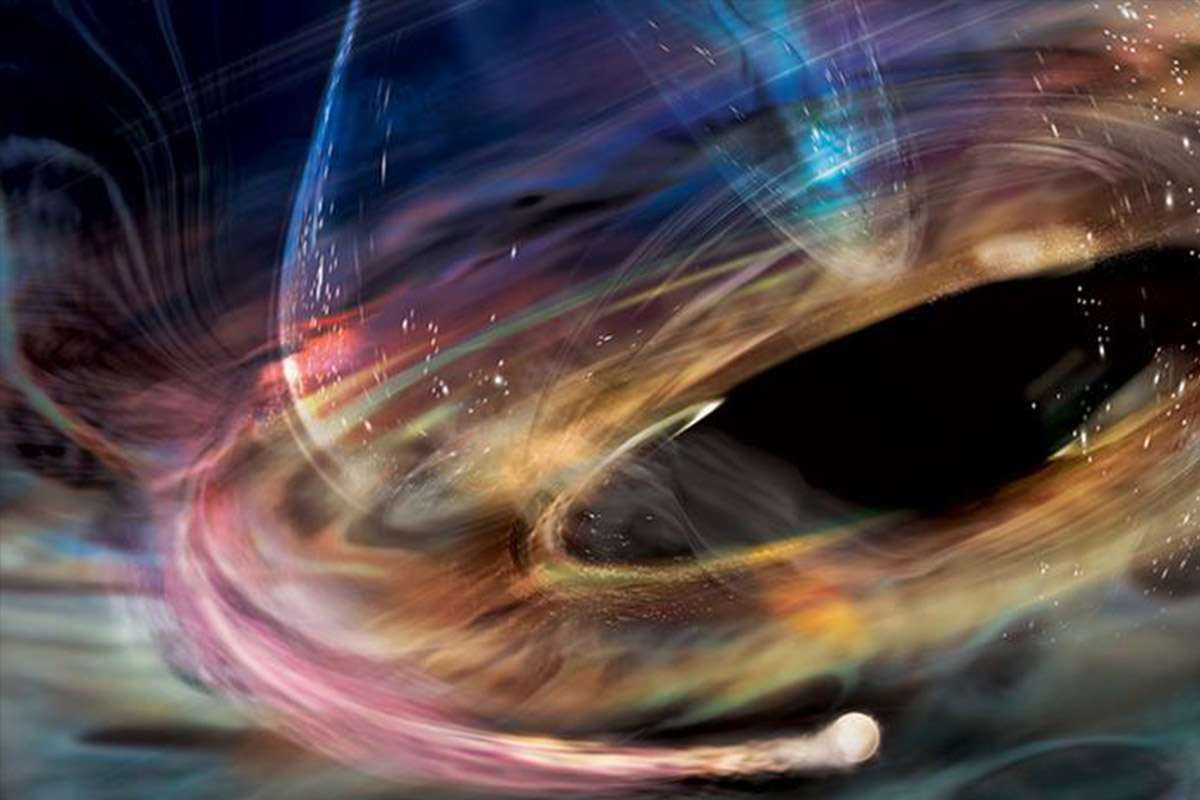
In this artist’s rendering, a stream of matter trails a white dwarf orbiting within the innermost accretion disk surrounding 1ES 1927’s supermassive black hole. Credit: Aurore Simonnet/ Sonoma State University.
X-ray flashes from a nearby supermassive black hole have accelerated mysteriously, suggesting influence from a dead star.
Massachusetts Institute of Technology astronomers have reported the source of the X-ray flashes could be the core of a dead star that’s teetering at the black hole’s edge.
One supermassive black hole, 1ES 1927+654, has kept astronomers glued to their scopes for the last several years. First came a surprise disappearance, and now, a precarious spinning act.
The black hole is about as massive as a million suns and sits in a galaxy that is 100 million light-years away.
In 2018, astronomers at MIT and elsewhere observed that the black hole’s corona — a cloud of whirling, white-hot plasma — suddenly disappeared, before reassembling months later. The brief though dramatic shut-off was a first in black hole astronomy.
Members of the MIT team have now caught the same black hole exhibiting more unprecedented behaviour. The astronomers have detected flashes of X-rays coming from the black hole at a steadily increasing clip.
Over a period of two years, the flashes, at millihertz oscillations, increased in frequency from every 18 minutes to every seven minutes. This dramatic speed-up in X-rays has not been seen from a black hole until now.
The researchers explored a number of scenarios for what might explain the flashes.
They believe the most likely culprit is a spinning white dwarf — an extremely compact core of a dead star that is orbiting around the black hole and getting precariously closer to its event horizon, the boundary beyond which nothing can escape the black hole’s gravitational pull.
If this is the case, the white dwarf must be pulling off an impressive balancing act, as it could be coming right up to the black hole’s edge without actually falling in.
Megan Masterson, a graduate student in physics at MIT, who co-led the discovery, said: “This would be the closest thing that we know of around any black hole.
“This tells us that objects like white dwarfs may be able to live very close to an event horizon for a relatively extended period of time.”
If a white dwarf is at the root of the black hole’s mysterious flashing, it would also give off gravitational waves, in a range that would be detectable by next-generation observatories such as NASA’s Laser Interferometer Space Antenna (LISA).
Co-author Erin Kara, associate professor of physics at MIT, said: “These new detectors are designed to detect oscillations on the scale of minutes, so this black hole system is in that sweet spot.”
Nothing normal
Kara and Masterson were part of the team that observed 1ES 1927+654 in 2018, as the black hole’s corona went dark, then slowly rebuilt itself over time.
For a while, the newly reformed corona — a cloud of highly energetic plasma and X-rays — was the brightest X-ray-emitting object in the sky.
Kara said: “It was still extremely bright, though it wasn’t doing anything new for a couple years and was kind of gurgling along. But we felt we had to keep monitoring it because it was so beautiful.
“Then we noticed something that has never really been seen before.”
In 2022, the team looked through observations of the black hole taken by the European Space Agency’s XMM-Newton, a space-based observatory that detects and measures X-ray emissions from black holes, neutron stars, galactic clusters, and other extreme cosmic sources.
They noticed that X-rays from the black hole appeared to pulse with increasing frequency. Such ‘quasi-periodic oscillations’ have only been observed in a handful of other supermassive black holes, where X-ray flashes appear with regular frequency.
In the case of 1ES 1927+654, the flickering seemed to steadily ramp up, from every 18 minutes to every seven minutes over the span of two years.
Masterson said: “We’ve never seen this dramatic variability in the rate at which it’s flashing. This looked absolutely nothing like a normal black hole.”
The fact that the flashing was detected in the X-ray band points to the strong possibility that the source is somewhere very close to the black hole.
The innermost regions of a black hole are extremely high-energy environments, where X-rays are produced by fast-moving, hot plasma.
X-rays are less likely to be seen at further distances, where gas can circle more slowly in an accretion disk.
The cooler environment of the disk can emit optical and ultraviolet light, but rarely gives off X-rays.
Kara said: “Seeing something in the X-rays is already telling you you’re pretty close to the black hole.
“When you see variability on the timescale of minutes, that’s close to the event horizon, and the first thing your mind goes to is circular motion, and whether something could be orbiting around the black hole.”
X-ray kick-up
Whatever was producing the X-ray flashes was doing so at an extremely close distance from the black hole, which the researchers estimate to be within a few million miles of the event horizon.
Masterson and Kara explored models for various astrophysical phenomena that could explain the X-ray patterns that they observed, including a possibility relating to the black hole’s corona.
Masterson said: “One idea is that this corona is oscillating, maybe blobbing back and forth, and if it starts to shrink, those oscillations get faster as the scales get smaller. But we’re in the very early stages of understanding coronal oscillations.”
A more likely scenario, and one that scientists have a better grasp on in terms of the physics involved, has to do with a daredevil of a white dwarf.
Masterson added: “These things are really small and quite compact, and we hypothesise that it’s a white dwarf that is getting so close to the black hole.”
According to the modelling, the researchers estimate the white dwarf could have been about one-tenth the mass of the sun. In contrast, the supermassive black hole itself is on the order of one million solar masses.
When any object gets this close to a supermassive black hole, gravitational waves are expected to be emitted, dragging the object closer to the black hole.
As it circles closer, the white dwarf moves at a faster rate, which can explain the increasing frequency of X-ray oscillations that the team observed.
The white dwarf is practically at the precipice of no return and is estimated to be just a few million miles from the event horizon.
However, the researchers predict that the star will not fall in. While the black hole’s gravity may pull the white dwarf inward, the star is also shedding part of its outer layer into the black hole.
This shedding acts as a small kick-back, such that the white dwarf — an incredibly compact object itself — can resist crossing the black hole’s boundary.
Kara said: “Because white dwarfs are small and compact, they’re very difficult to shred apart, so they can be very close to a black hole.
“If this scenario is correct, this white dwarf is right at the turn around point, and we may see it get further away.”


