



An artist’s impression of how the four exoplanets orbiting Barnard’s Star, the closest single star system to Earth, may look. Credit: International Gemini Observatory/ NOIRLab/ NSF/ AURA/ P Marenfeld. CC BY.
Gemini North’s MAROON-X instrument finds evidence for four mini-Earth exoplanets around our famous cosmic neighbour, Barnard’s Star.
For a century, astronomers have been studying Barnard’s Star in the hope of finding planets around it. First discovered by EE Barnard at Yerkes Observatory in 1916, it is the nearest single star system to Earth.
Barnard’s Star is classified as a red dwarf — low-mass stars that often host closely-packed planetary systems, often with multiple rocky planets.
Red dwarfs are extremely numerous in the Universe, so scientists are interested in understanding the environments of the planets they host.
Now, using in part the Gemini North telescope, one half of the International Gemini Observatory, partly funded by the US National Science Foundation and operated by NSF NOIRLab, astronomers have discovered four sub-Earth exoplanets orbiting the star.
One of the planets is the least massive exoplanet ever discovered using the radial velocity technique, indicating a new benchmark for discovering smaller planets around nearby stars.
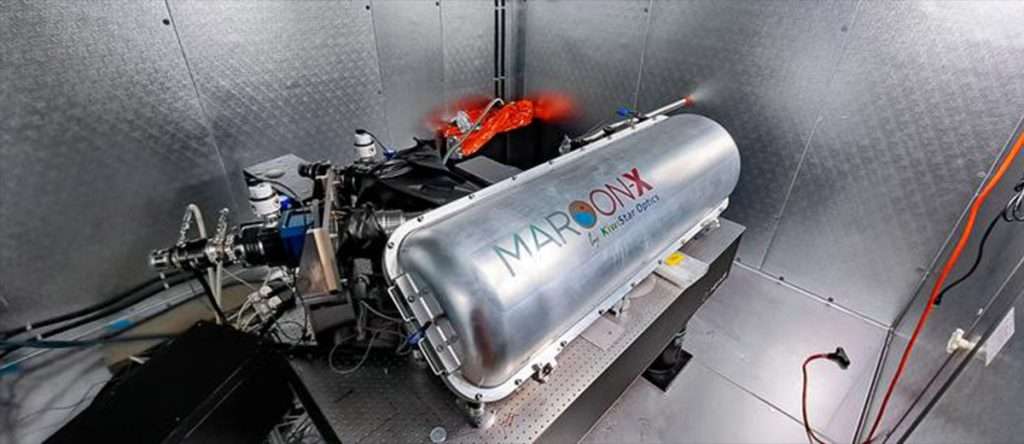
The MAROON-X instrument is attached to the Gemini North telescope, one half of the International Gemini Observatory, funded in part by the U.S. National Science Foundation and operated by NSF NOIRLab, where it dissects light from the telescope to capture information about faraway planets. Credit: International Gemini Observatory/ NOIRLab/ NSF/ AURA/ J Bean. CC BY.
MAROON-X
Astronomer Jacob Bean, from the University of Chicago, and his team, created an instrument called MAROON-X, which is designed specifically to search for distant planets around red dwarf stars.
MAROON-X hunts for exoplanets using the radial velocity technique, meaning it detects the subtle back and forth wobble of a star as its exoplanets gravitationally tug on it, which causes the light emitted by the star to shift ever so slightly in wavelength.
The powerful instrument measures these small shifts in light so precisely that it can even tease apart the number and masses of the planets that must be circling the star to have the observed effect.
After rigorously calibrating and analysing data taken during 112 nights over a period of three years, the team found solid evidence for three exoplanets around Barnard’s Star, two of which were previously classified as candidates.
The team also combined data from MAROON-X with data from a 2024 study done with the ESPRESSO instrument at the European Southern Observatory’s Very Large Telescope in Chile to confirm the existence of a fourth planet, elevating it as well from candidate to bona fide exoplanet.
First author of the paper, Ritvik Basant, a PhD student at the University of Chicago, said: “It’s a really exciting find — Barnard’s Star is our cosmic neighbour, and yet we know so little about it.
“It’s signalling a breakthrough with the precision of these new instruments from previous generations.”
Better estimates
The newly discovered planets are most likely rocky planets, rather than gas planets like Jupiter.
However, this will be difficult to pin down with certainty since, because of the angle we observe them from Earth, the planets do not cross in front of their star, which is the usual method for determining a planet’s composition.
But with information from similar planets around other stars, the team will be able to make better estimates of their makeup.
They were, however, able to rule out with a fair degree of certainty the existence of other exoplanets with masses comparable to Earth in Barnard Star’s habitable zone — the region of space around a star that is just right to allow liquid water on an orbiting planet’s surface.
Barnard’s Star has been called the ‘great white whale’ for planet hunters; several times over the past century, groups have announced evidence that suggested planets around Barnard’s Star, only for them to be subsequently disproved.
But these latest findings give a much larger degree of confidence than any previous result.
Basant said: “We observed at different times of night on different days. They’re in Chile; we’re in Hawai‘i. Our teams didn’t co-ordinate with each other at all.
“That gives us a lot of assurance that these aren’t phantoms in the data.”
New era
The four planets, each only about 20 to 30% the mass of Earth, are so close to their home star that they zip all the way around it in a matter of days. The fourth planet is the least massive planet discovered to date using the radial velocity technique.
The team hopes this will spark a new era of finding more and more sub-Earth exoplanets in the Universe.
Most rocky planets found so far are much larger than Earth, and they appear to be fairly similar throughout the Milky Way Galaxy.
But there are reasons to think that smaller exoplanets have more widely varied compositions.
As scientists find more of them, they can begin to tease out more information about how these planets form and what makes them likely to have habitable conditions.
The research is published in The Astrophysical Journal Letters.


